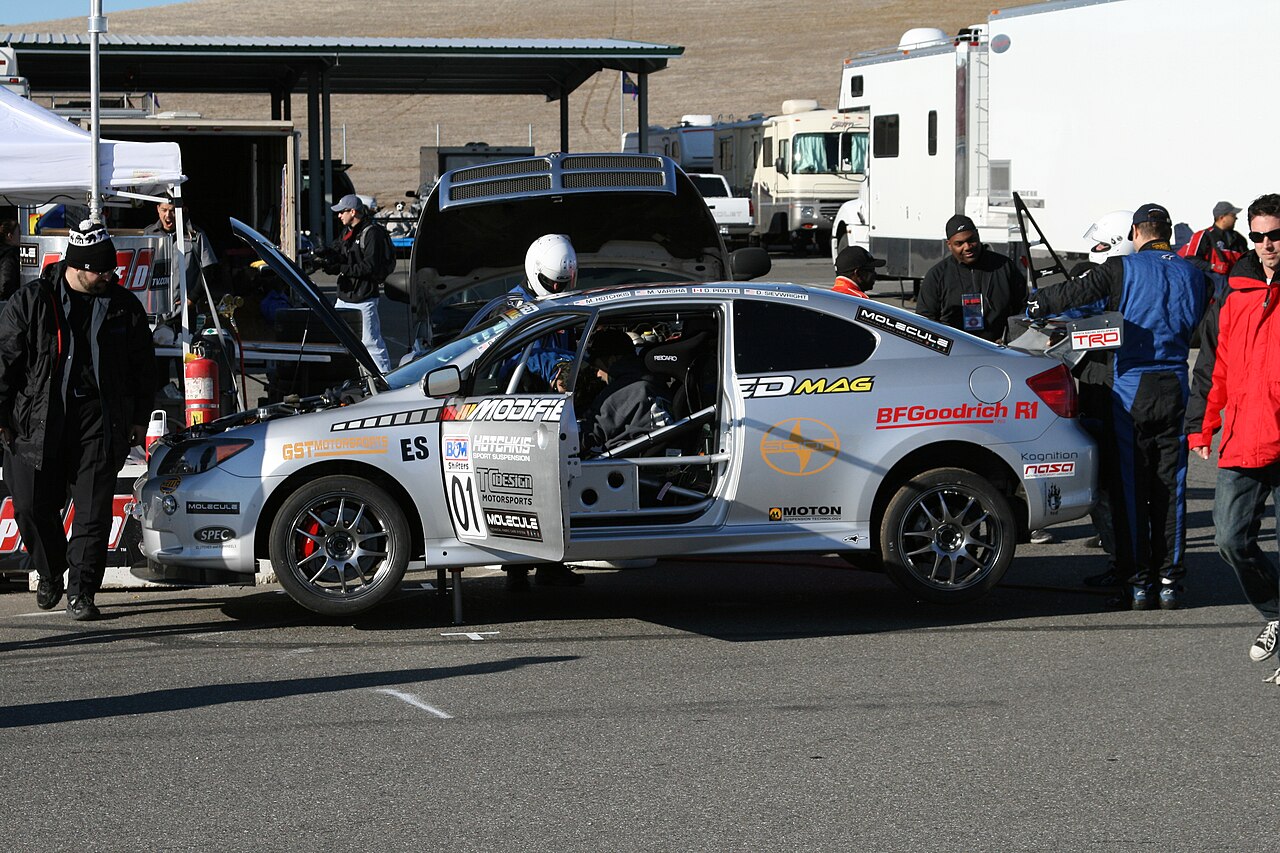
Chris Rado's F'Wing tC: Scion's Time Attack Legend
- Who Chris Rado and World Racing are, and their Scion factory ties
- Why the tC’s front-wheel-drive layout made it an unlikely time attack platform
- The oversized rear wing that earned the car its “F’Wing tC” nickname
- Where the car competed and what it meant for the Scion tC’s aftermarket reputation
TL;DR: Chris Rado, founder of World Racing, built a heavily turbocharged Scion tC time attack car that ran the Global Time Attack circuit under Scion’s factory-backed racing program. Its most recognizable feature was an oversized rear wing — tall enough and flat enough that the community started calling the car the “F’Wing tC,” a nickname that stuck harder than the car’s actual event results ever did.
Chris Rado’s Scion tC didn’t win Global Time Attack because it was a front-wheel-drive coupe — it won attention because World Racing proved a front-wheel-drive coupe could show up at all.
Who Is Chris Rado and What Is World Racing?
Chris Rado is a Southern California tuner and racer who founded World Racing, a shop that built its name campaigning Scion vehicles under Scion’s factory-supported racing efforts in the mid-to-late 2000s. Rado is better known to most enthusiasts through Formula Drift, where World Racing–prepared Scion tCs were regular competitors, but the shop’s time attack program is what produced the car this piece is about.
World Racing’s pitch was straightforward: take the platform Toyota marketed as an affordable, front-wheel-drive commuter coupe, and prove it could hang in disciplines built almost entirely around rear-wheel-drive and all-wheel-drive cars. Time attack — timed, single-car runs against the clock rather than wheel-to-wheel racing — was the discipline where that argument could be made cleanly, since it isolates chassis and power against a stopwatch rather than head-to-head positioning.
Why Build a Front-Wheel-Drive Time Attack Car?
A front-wheel-drive time attack build is unusual because the front tires are asked to do everything — put down power, turn the car, and manage weight transfer under braking — while most serious time attack fields are dominated by AWD platforms (Mitsubishi Evo, Subaru STI) or purpose-built RWD chassis. Running the tC anyway made the platform’s aftermarket ceiling part of the story: if a factory-backed team could get a front-drive commuter coupe into contention, it said something about how far the 2AZ-FE-equipped tC platform could be pushed with forced induction, chassis stiffening, and aggressive aerodynamics.
That’s the context that matters for owners today — the F’Wing tC wasn’t a case of Scion building a bespoke race car from scratch. It was a modified production tC, which is exactly why the car resonated with an owner community that was doing smaller versions of the same mods (turbo kits, coilovers, aero) in their driveways.
Where Did the “F’Wing” Nickname Come From?
The nickname comes directly from the car’s most visually aggressive modification: a tall, flat-profile rear wing, oversized relative to anything Toyota or Scion ever offered for the tC, mounted high enough on risers to work in cleaner airflow above the car’s roofline. Community coverage of the car — including the Global Time Attack season-opener recap that first circulated the “F’Wing tC” name — leaned on that wing as the car’s defining feature, and the name outlasted most people’s memory of where exactly the car finished that season.
Big wings on front-wheel-drive time attack cars serve a specific purpose beyond looks: with no rear-drive power to manage, the rear wing’s downforce is almost entirely about keeping the rear planted during trail-braking and mid-corner direction changes, letting the driver load the front tires more aggressively without the rear stepping out.
What This Means for the tC Platform Today
The F’Wing tC’s competition record isn’t the reason it still gets referenced in the Scion community — it’s that it demonstrated, publicly and under factory backing, that the tC’s chassis and 2AZ-FE (Gen 1) or 2AR-FE (Gen 2) engine had real headroom for forced induction and aero work. If you’re building a track-focused tC today, the same fundamentals World Racing worked with still apply: the factory suspension geometry responds well to coilovers and sway bar upgrades, and the engine bay has enough room for a properly plumbed turbo kit without major surgery.
Frequently Asked Questions
Was the Scion tC ever an official factory race car?
▼
Not from the factory floor — Scion never sold a homologated race variant of the tC. The F’Wing tC was a heavily modified production tC campaigned by World Racing under Scion’s factory-supported racing sponsorship, which is a different arrangement than a manufacturer building a purpose-made race chassis.
What is Global Time Attack?
▼
Global Time Attack is a competitive time attack series where cars run individual timed laps rather than racing wheel-to-wheel, with classes separating builds by aero, tire, and modification level. It’s one of the longest-running US time attack series and a common proving ground for aggressively modified street-based platforms.
Can a street-driven Scion tC realistically be built into a track car?
▼
Yes — the tC’s factory chassis and both the 2AZ-FE (Gen 1) and 2AR-FE (Gen 2) engines have a well-documented aftermarket for coilovers, sway bars, and turbo kits. It won’t match a purpose-built time attack car without similar investment, but the platform responds well to the same categories of mods World Racing used.
Keep Building
Related Model
Scion tC Owner Hub
Guides, specs, mods and more.