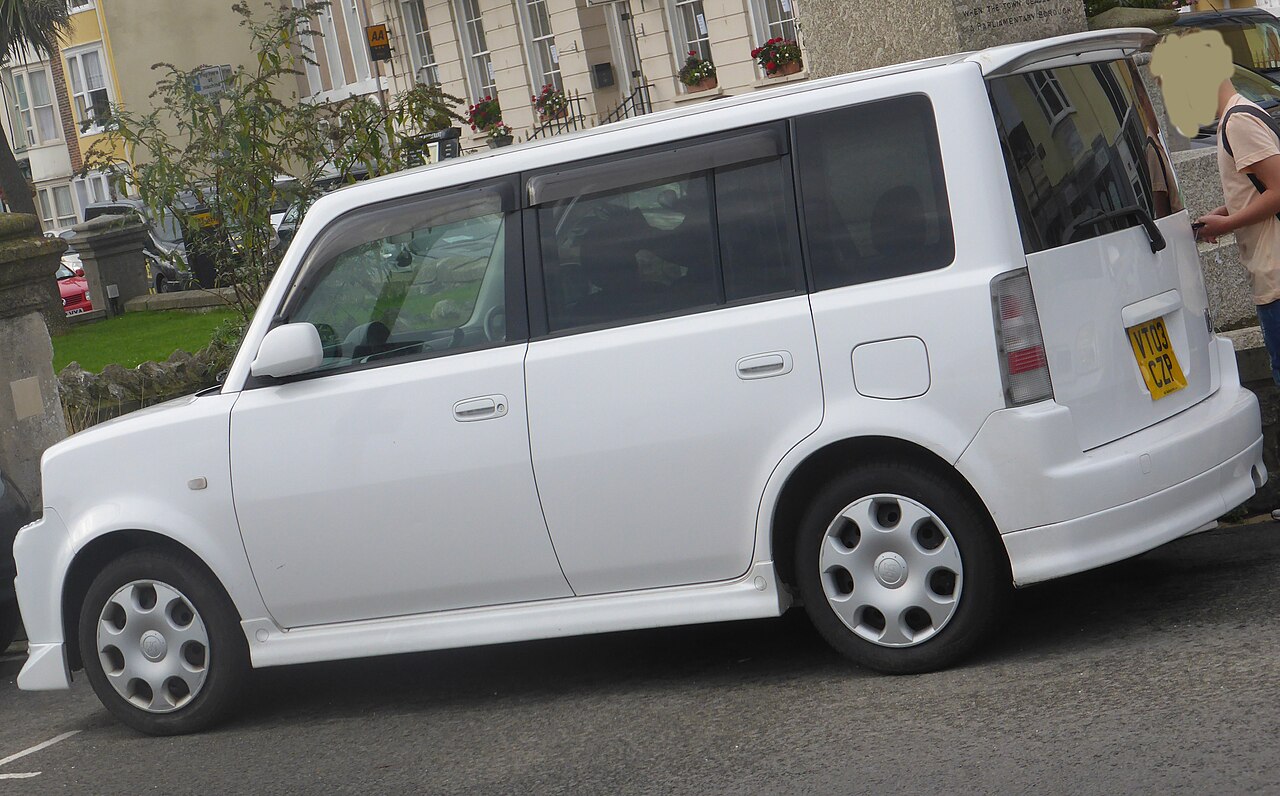
Toyota bB (NCP31): The JDM Car Behind the Scion xB
- How the Japan-market Toyota bB became the US-market Scion xB
- What actually changed (and didn’t) between the bB and the xB
- The JDM styling scene the bB came from, and why it still shapes xB builds
- What xB owners can and can’t borrow from bB-specific parts catalogs
TL;DR: The first-generation Scion xB (2004–2006) is a badge-and-market-adapted version of the Japan-market Toyota bB, chassis code NCP31 — a boxy, tall-roof compact Toyota sold in Japan starting in 2000 that developed its own JDM styling scene (low, wide, VIP-adjacent stance builds) years before it ever reached the US as a Scion. That heritage is why so much of the first-gen xB’s styling identity — boxy proportions treated as a stance canvas rather than something to disguise — traces directly back to bB culture, not anything Scion invented for the American market.
The Scion xB owes its entire visual identity to a car most American owners have never seen in person: the Toyota bB.
Is the Scion xB Just a Rebadged Toyota bB?
The first-generation Scion xB (2004–2006) is a market-adapted version of the Japan-market Toyota bB, built on the same NCP31 platform, though “rebadged” undersells how deliberate the adaptation was. Toyota created Scion specifically to import boxy, youth-oriented Japanese domestic market models to the US without the assumptions that came with the Toyota badge, and the bB — already a known quantity in Japan since 2000 — was a natural first candidate given how far outside American compact-car norms its proportions were.
Toyota didn’t just swap emblems: US-market changes included federalized safety and emissions equipment, different trim and options packaging, and styling tweaks to the front and rear fascias, but the core boxy monospace silhouette, tall roofline, and interior packaging that made the bB distinctive in Japan carried straight through to the xB.
Where Did the bB’s Styling Culture Come From?
The bB’s styling culture came out of Japan’s early-2000s domestic tuning scene, where its slab-sided, tall-roof shape got treated less like something to hide and more like a blank canvas for aggressive stance work — wide, low-offset wheels, dropped ride height, and body kits that leaned into the boxiness rather than smoothing it out. That’s a meaningfully different starting point than most American compact cars of the same era, which is a big part of why the xB attracted a stance-and-JDM-styling crowd in the US almost immediately rather than developing an entirely separate American mod culture from scratch.
What Does This Mean for xB Builds Today?
For a first-gen xB owner, the bB heritage mostly shows up in two practical ways: chassis and drivetrain hard parts (suspension components, some interior trim) share enough commonality with JDM bB parts catalogs that imported bB-specific parts occasionally cross over, and the styling direction (JDM wheels, lowered stance, boxy-forward aesthetic rather than disguising the shape) has decades of established precedent to pull from rather than being a newer trend. It’s worth noting this crossover applies most directly to the first-generation xB (2004–2006) — the second-generation xB (2008–2015) was restyled on a different platform and moved further from the original bB’s specific proportions, even though it kept the tall-roof, boxy family resemblance.
Should I Look for bB-Specific Parts for My xB?
You should treat bB-specific parts as a secondary option, not a primary parts source, since fitment between JDM bB and US-market first-gen xB components isn’t guaranteed to be identical across every part category even where the platforms share their core architecture. Always cross-reference a specific part number against your xB’s exact trim and year before assuming a bB-catalog part will bolt on — the platforms are close relatives, not identical twins in every subsystem.
Frequently Asked Questions
Was the Toyota bB ever sold in the US?
▼
No — the bB was a Japan-market-only model. US buyers got the adapted version under the Scion xB nameplate starting in 2004, with federalized equipment and market-specific styling changes rather than a direct import of the JDM car.
Does the second-generation xB share the same bB heritage?
▼
Only loosely — the second-generation xB (2008–2015) moved to a different platform and styling direction, keeping the tall-roof boxy family look without the direct NCP31 chassis connection that defines the first-generation car.
Can I import bB-specific parts for my first-gen xB?
▼
Sometimes, for parts categories where the platforms genuinely share hardware, but it’s not guaranteed across every component. Always verify a specific part against your exact xB trim and year rather than assuming bB-catalog compatibility by platform name alone.
Keep Exploring
- Scion xB owner hub →
- Gen 1 vs Gen 2 xB buyer’s guide → — how the bB-derived original compares to its much larger successor
- xB maintenance and mod guides →
- See real xB community builds →
Related Model
Scion xB Owner Hub
Guides, specs, mods and more.