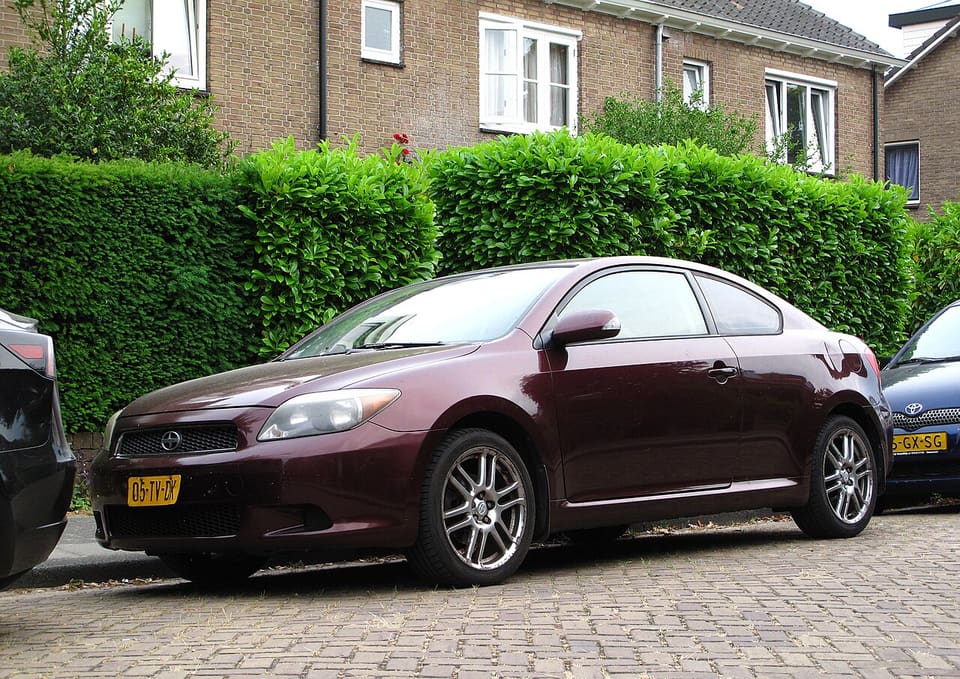
Scion 2AZ-FE Oil Consumption: Causes, Fixes & What It Costs
- The actual mechanical cause of 2AZ-FE oil consumption
- Which Scion models and model years are affected
- How to run a proper oil consumption test before spending money
- What the permanent repair involves — and realistic alternatives
TL;DR: The 2.4L 2AZ-FE engine in the Scion tC (2005–2010) and xB (2008–2015) burns oil because the oil-control ring drain holes in the factory pistons are small enough to clog with carbon. Once clogged, oil can’t drain back to the crankcase and gets burned in the combustion chamber instead. The permanent fix is replacing the pistons and rings — an engine-out job. Toyota’s warranty enhancement program that once covered this has expired, so most owners today either manage consumption with frequent oil checks or budget for the rebuild.
If your tC or xB is a quart low between oil changes and there’s no puddle on your driveway, you almost certainly have this problem. It’s not a mystery and it’s not your fault — it’s a known design issue with a well-understood cause.
Why Does the Scion 2.4L 2AZ-FE Burn Oil?
The 2AZ-FE burns oil because the oil return passages behind the oil-control ring are undersized and clog with carbon deposits over time. When those passages block, the oil-control ring can no longer scrape oil off the cylinder wall and return it to the crankcase. That oil stays on the wall, gets pulled into the combustion chamber on the intake stroke, and burns off with the fuel charge.
This is a design problem, not a wear problem. It happens on well-maintained engines. It gets worse with age and mileage because carbon accumulation is cumulative — which is why consumption often appears suddenly somewhere between 60,000 and 120,000 miles rather than gradually from new.
Two things accelerate it:
- Extended oil change intervals. Old, oxidized oil leaves more deposits, which clog the passages faster.
- Short-trip driving. An engine that never reaches full operating temperature doesn’t burn off moisture and fuel dilution, both of which contribute to deposit formation.
Neither causes the problem. Both make it arrive sooner.
Which Scion Models and Years Are Affected?
The affected engine is the 2.4L 2AZ-FE, which Scion used in two places:
| Model | Years | Engine | Affected |
|---|---|---|---|
| Scion tC (Gen 1) | 2005–2010 | 2AZ-FE 2.4L | Yes |
| Scion tC (Gen 2) | 2011–2016 | 2AR-FE 2.5L | No — different engine |
| Scion xB (Gen 2) | 2008–2015 | 2AZ-FE 2.4L | Yes |
| Scion xB (Gen 1) | 2004–2006 | 1NZ-FE 1.5L | No — different engine |
If you have a 2011 or newer tC, you have the 2AR-FE and this guide doesn’t apply to you. The engine change at the generation break is the single most important thing to establish before you start diagnosing. Not sure which you have? Decode your VIN — it identifies the generation and engine directly.
The same 2AZ-FE appeared in the Toyota Camry, RAV4, Solara, Matrix and Corolla XRS of the same era, so most of the community knowledge, parts availability, and shop familiarity comes from the much larger Toyota-badged population.
How Do I Know If My Engine Is Burning Oil?
Run a controlled consumption test: fill to the full mark, drive exactly 1,000 miles without topping up, then measure how much you need to add to return to full. Anything approaching a quart per 1,000 miles is the failure mode described here.
For reference, Toyota’s own dealer-level consumption standard treated roughly one quart per 1,200 miles as the threshold for abnormal consumption. A healthy 2AZ-FE should use well under half a quart between 5,000-mile changes.
Symptoms that point at ring-related consumption rather than a leak:
- Oil level drops with no visible leaks and no oil on the driveway or splash shield
- Blue-tinged smoke on cold start or under hard acceleration, sometimes only briefly
- Spark plugs fouled with oil — pull one and look at the electrode
- Low-oil warning light appearing between scheduled changes
Rule out the cheap stuff first. A leaking valve cover gasket, a failed VVT-i oil line, or a clogged PCV valve can all mimic consumption, and all three are dramatically cheaper to fix than pistons. A PCV valve in particular is a sub-$20 part and is worth replacing before you conclude anything.
Is There Still Free Warranty Coverage for This?
No. Toyota ran a Warranty Enhancement Program covering oil consumption on 2AZ-FE engines, but its coverage window has long since closed — it was time- and mileage-limited, and even the newest affected vehicles have aged out. Any repair today is out of pocket.
It’s still worth a phone call to a Toyota dealer with your VIN before you spend money, for two reasons: it confirms definitively whether anything remains open on your specific vehicle, and it tells you whether the piston repair was ever already performed by a previous owner. That second point matters — a car that’s had the updated pistons installed shouldn’t develop the problem again.
While you’re checking coverage, verify no open safety recalls are outstanding on the same VIN. Safety recalls, unlike warranty enhancement programs, never expire and are always free.
What Is the Permanent Fix?
The permanent fix is replacing the pistons and piston rings with Toyota’s updated design, which has enlarged oil return passages that resist clogging. This requires removing the engine or at minimum dropping the subframe and pulling the head and pan — it is not a driveway job for most people.
Realistically this means:
- Labor is the dominant cost. The parts themselves are moderate; the teardown and reassembly are where the money goes. Expect a four-figure quote at an independent shop and meaningfully more at a dealer.
- Do the wear items while it’s apart. Timing chain components, water pump, and all accessible seals and gaskets are far cheaper to replace now than to revisit later.
- Get the current part numbers from a dealer parts counter using your VIN. Toyota supersedes part numbers over time, and the correct piston set depends on your exact engine and build date. Don’t order from a forum post — verify against your VIN.
For many owners of a 15–20 year old Scion, the honest math is that this repair costs a significant fraction of the car’s value. That’s a legitimate reason to choose management over repair, and it’s not a failure to do so.
What Can I Do Without Rebuilding the Engine?
The realistic non-rebuild approach is to slow the consumption and monitor it closely rather than eliminate it. None of the following are permanent fixes, and anyone who tells you otherwise is selling something.
Check the oil every other fuel fill. This is the single most important habit. The genuine danger of this problem isn’t the oil consumption itself — it’s running the engine low on oil without knowing. Bearing damage from oil starvation turns a manageable annoyance into a destroyed engine.
Consider a slightly heavier oil. The factory specification is 0W-20. Many owners of high-mileage, actively-consuming 2AZ-FE engines run 5W-30 to reduce the rate of consumption. This is a deliberate deviation from Toyota’s specification and it’s a trade-off, not a free win — thicker oil flows less readily at cold start. It’s a defensible choice on an engine already burning oil, and a poor one on a healthy engine.
A piston soak may help — sometimes. Introducing a solvent through the spark plug holes to dissolve carbon in the ring lands is a genuine technique, and some owners report reduced consumption afterward. Results are inconsistent and it does nothing about the underlying passage sizing. Treat it as a low-cost attempt with modest expectations, not a repair.
Replace the PCV valve. Cheap, easy, and a clogged one measurably increases crankcase pressure and therefore oil consumption. Do this regardless.
Shorten your oil change interval. If the engine is consuming oil, the remaining oil is working harder and degrading faster. 5,000 miles or less, and check the level constantly.
Frequently Asked Questions
Is it safe to keep driving a Scion that burns oil?
Yes, provided you check the oil level frequently and never let it run low. The consumption itself is not immediately destructive — running the engine below minimum oil level is. Owners routinely drive these engines for years while topping up between changes. The moment you stop checking is the moment it becomes dangerous.
Does switching to thicker oil actually reduce consumption?
Often, modestly. Heavier oil is less able to slip past a compromised oil-control ring, so many owners see a reduced rate after moving from 0W-20 to 5W-30. It does not fix the clogged return passages, and it deviates from Toyota’s factory specification — a reasonable trade on an engine already consuming oil, but not something to do preemptively on a healthy one.
Does the second-generation Scion tC have this problem?
No. The 2011–2016 tC uses the 2.5L 2AR-FE, a different engine that does not share the 2AZ-FE’s oil-control ring design. If you’re shopping for a tC and want to avoid this issue entirely, buy a 2011 or later car.
Can I tell if a used Scion has already had the piston repair?
A Toyota dealer can look up warranty repair history against the VIN and tell you whether the piston work was ever performed. This is worth doing before buying any 2AZ-FE Scion — a car with the updated pistons already installed is meaningfully more valuable than one without, and the seller may not even know it was done.
Staying on top of oil changes is the highest-leverage thing you can do with this engine — the Scion tC oil change walkthrough has the exact specs and torque figures for both generations. For factory fluid capacities and service intervals across the whole lineup, see the Scion maintenance dashboard, and for everything else tC-specific, start at the Scion tC owner hub.
More for your Scion
Scion tC Hub
All guides, articles, and builds for the tC.